Goals 2014: 5 Questions For People Using Social Media To Connect With Others

Social Media Activity

Just Some Of The Ways To Be Active On Social Media

How many different channels do you use to pursue your social media goals and present your brand online to the world?  As I researched this post I realised just how many social media channels there are, and how little time there would be to make the best use of all of them.  That’s why I’m referring to just a handful of platforms.

US versus UK Social Media Statistics

US data from 2013 undertaken by the Pew Research Centre (a non-partisan ‘fact tank’) is relevant here.  They have broken down online activity to identify who is using social networking (73% of US adults are apparently) and where they spend time: Would you say your strategy is to form links with 16% on Google +, or the 22% of adults on Linkedin (which celebrates its 11th birthday on 5 May)?  Connect with the 18% of adults using Twitter?  Or do you relate more with the 71% of all adults using Facebook?

According to Ofcom in the UK 55% of adults owning mobile web enabled devices use them to visit social networking sites, or networking apps.  That’s a hefty segment of users who you could be reaching.  Assuming you can find the right channel to engage with the demographic you have

Google+ How Is It For You?

It is a timely question as JP Mangalindan, writing online for CNN Fortune and Money, has speculated about the platform’s future in a recent tech article   How productive a space is Google+ for you?

Site Statistics

We’ve all visited sites where the most recent post was six months ago.  Perhaps the site’s owner looked at their site statistics, felt it wasn’t getting enough traffic and abandoned it for that reason.  I wonder what signal that sends to visitors and to corporations like Google who created the site?

5 Questions For People Using Social Media To Connect With Others

So there is high take up with social media in general, although some platforms are more popular than others.  All of this  prompts me to ask the following:

  • What story do your posts tell about your brand (well established leader in your sector, or attention worthy new entrant)?
  • What timing strategy do you follow when you post to your social media sites (Weekly, or less often? Midweek, or weekend?)
  • How many new visitors are you adding by posting?
  • What do your visitors gain by looking at your site (insight from material you create; engagement with other peoples’ posts which you curate and repost; more information about your work)?
  • When visiting your site on mobile devices do people miss out on some of the desktop content (or could they browse and even buy in both places)?

Your answers to those questions can help you assess the return on the time you invest, in creating and curating social media posts.

Feel free to browse the other ideas relating to your work and life goals in the Archive section here, on Facebook and Google+ too.  Or if you are a Linkedin user you can View Roger Dennison’s profile and connect with me there.
Goals 2014: How Well Does Your Leadership Reflect Your Equality And Diversity Goals?

How Effective Is Your Leadership On Equality And Diversity?

How Effective Is Your Leadership On Equality And Diversity?

If you are like many leaders it is probably a challenge to get through your To Do list and deliver your everyday goals.  If you prioritise your medium and longer term goals too, this post may appeal to you.

What Effects Does Dominant Group Thinking Produce?

Here is a 58 minute video by anti-racist speaker Tim Wise, which is worth a look, if you have time and you have stretching leadership goals which are inspired by your equality and diversity values.  In case you haven’t time for the full video there are excerpts on Youtube which you can search for.

To my mind the key take away from the video is this: Being in the dominant group can leave you thinking you have the luxury of not having to care what other people think.  That attitude will make it harder to deliver on equality and diversity goals.

The upside of dominant-group thinking is simple: You face no obstacles to getting your goals accomplished.  You don’t experience anxiety.  You also don’t need to spend time on reflection about the impact of your words.  You can behave as you want to.  After all, you are acting on behalf of people like yourself, aren’t you?

How Do People From Diverse Backgrounds Respond To Dominant Group Thinking?

People from diverse backgrounds in your current or potential audience may take a different view.  On the least damaging end of the scale if you misspeak on a one-off basis you may not face any lasting consequences.  Get in wrong often enough and the authenticity of your brand values may be called into question.

What Are The Real World Consequences Of Sending Out The Wrong Equality And Diversity Messages?

In the US, major league basketball franchise owner Donald Sterling has experienced some major consequences following media coverage of comments he made about the sort of person he wanted courtside.  Being banned for life from the NBA and forced to sell his team, the LA Clippers for $850m, may influence him to rethink his approach to equality and diversity.

In the UK, BBC television Top Gear’s presenter Jeremy Clarkson is reportedly on his final warning from the corporation, after another controversial week.  Notwithstanding the 350 million viewers his programme receives globally he is having to rethink his approach to how he broadcasts.

Thee are high profile examples, but I think the basic principles are applicable to businesses generally.  Take a few moments to review your situation.  How well do you feel your organisation is doing on Equality And Diversity at the moment?

What Question Can An Authentic Leader Ask Of Themselves To Improve Their Equality And Diversity Focus?

Whether you are in the US, UK or further afield here’s a question that can ask yourself to improve your leadership:

  • What action will I take, this month, as an authentic leader to help my organisation make better use of its diverse workforce (or to demonstrate our commitment to equality goals)?

Feel free to continue this conversation about the relationship between authentic leadership, your values, and equality and diversity within your organisation.  Do let me know what impact your action has, when you start to see some results.

By all means take a look at the further ideas relating to your work and life goals in the Archive section here, on Facebook and Google+ too.  Or if you are a Linkedin user you can View Roger Dennison’s profile and connect with me there.

Goals 2014: Want To Know How Volunteering Helps You Improve Your Morale?

Would you say your communication skills were above average?  Do your emails have clarity and purpose?  How about your clients, do they always engage with your messages, taking the necessary action as a result?

If you answered ‘Yes’ research suggests you probably accomplish a lot in your work, by getting your message across effectively.  I believe you will also gain if you spend some time as a volunteer, using those skills to benefit your community.

By offering your existing skills to a project you inevitably highlight your learning needs; this can lead you to acquire new abilities, gain confidence and benefit others in the process.  Your morale increases when your skills are being put to good use (OECD data suggests in the UK people spend 2 minutes daily in volunteer activity, compared to 6 minutes in Australia and 8 minutes in the US.  That’s just a snapshot of the positive energy being generated globally through volunteer effort).

Using Skills Well Benefits You & Your Community

Using Skills Well Benefits You & Your Community

In the short term by volunteering you will be affecting and improving the lives of a range of clients, prompting them to take action and make a difference in their own, plus others’ lives.  From my experience in England Community First (#commfirst on Twitter) projects and panels benefit from volunteers, like you, who can communicate effectively.

There are plenty of other voluntary projects you could offer your communication (or other) skills to, depending on your location.  Your local voluntary action co-ordinating organisation should be able to signpost you to a list of outfits in need.

So, when will you take the first step to put your skills to use for others’ benefit?  Doing this helps you find renewed purpose and confidence, which can feed back into your work and make you a more valuable member of staff.

Want to find out more about goals you can explore, relating to your work and life?  Then visit the Archive section here, or take a look on Facebook and Google+ too.

Goals 2014: Here’s 1 Action To Help You Improve Your Personal Presentation

Here are some questions for you to reflect on over the weekend.  How much effort do you put into the visual side of your personal brand?  Could your choice of work wear represent who you are more effectively?  What action will you take to improve your personal presentation this Spring?

What Does Leadership Look Like?

What Does Leadership Look Like?

Not too sure how to answer? No worries.  Here is a short video you can watch now as part of your personal improvement goal.  It was filmed at Ad Week Europe and in 4 minutes Gok Wan, Kathleen Saxton, and the Guardian’s John Plunkett outline some useful key presentation concepts.  Could this be another theme for you and your coach to explore when you discuss your goals and your values?

Feel free to look at the further ideas relating to your work and life goals in the Archive section on Facebook and Google+ too

Is Improving Your Work Your 2014 Goal? Here Are Your 3 Key Actions To Take In The Next Week

Was your week a mix of Highs and Lows?  Was one low your boss telling you that your
performance ‘must improve’?  If the answer is ‘Yes’ here are 3 actions to help you move forward in the next week, towards your performance improvement goal:

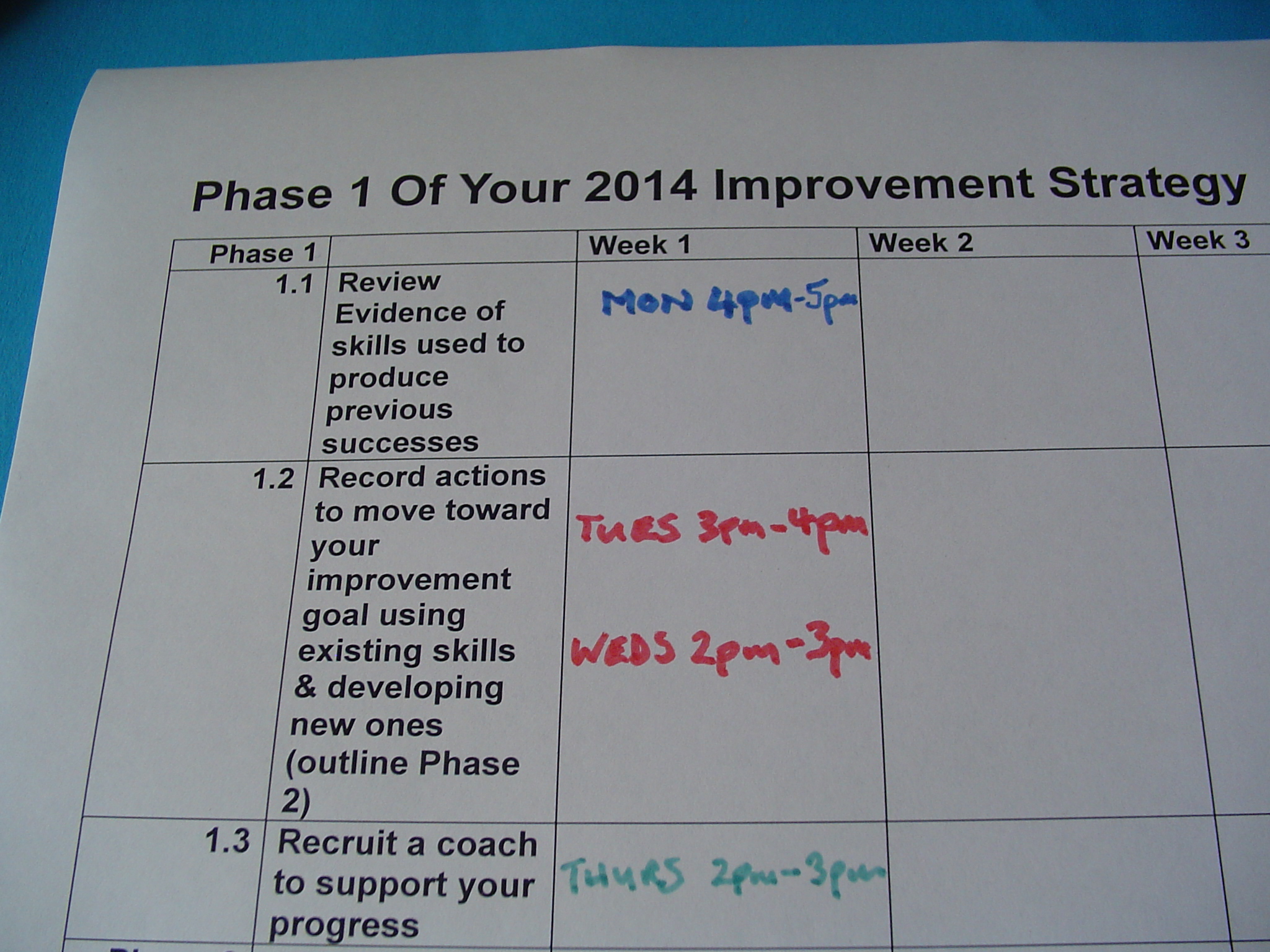
  • Review the evidence of your previously Successful, or Excellent, reports.  This helps you top up your self-esteem.  Positive customer feedback has always reflected the quality of your work.  Cultivate it from this point
    Your Improvement Strategy Will Move You Forward

    Your Improvement Strategy Will Move You Forward

    onwards.  Also plan how you will add to your key strengths, respect your values and earn more feedback.  Remember your boss’s view is probably changeable.  If not your psychological contract with your team may have ended.  Other bosses are out there.

  • Record the specifics of your next steps strategy, so you identify an immediate, positive, action you will take to start moving forward.  Call this Phase One of your plan.  Make it something constructive, that you know you can do well.  If that is not possible within your present role find another role that allows you to reassert your ability to do good work.  Outline what you want to accomplish in Phase Two of your plan, at the same time.
  • Recruit a skilled ally, ideally an experienced coach who: understands the significance of your work goals; recognises the importance of your values; will remain supportive as your performance rises and you start to fill in the detail of your Phase Two outline.

You are now good to go for Phase One of your plan.  Take these 3 constructive steps and your week ahead will be focused on improvement and positivity.

Good luck and feel free to get in touch with me to talk about your coaching needs, beyond the #MustImprove stage:  use the Contact tab above or visit me on Facebook  and Google+ too.

#YourGoals : When Will You Ask For The Things That You Need?

How Are You Feeling About Your 2014 Goals?

How Are You Feeling About Your 2014 Goals?

Do you have too little time to take a break from work? Or are you always too busy to make time for yourself (because you are prioritising someone else’s goals over your own)?

When you look at your answers to those questions, how happy are you with your reality? Are your authentic needs being met, at the same rate as the needs of those people around you?  How do your choices reflect your values; your standards of professional leadership; and your sense of personal fulfilment?

What Can You Do To Achieve An Authentic Balance In Your Life?

If you need to start adjusting your goals concerning that balance, there is a link in the next paragraph to a wonderfully simple TED* talk given by Dr Laura Trice, in February 2008.  Do yourself a favour and invest four minutes during your next break to look at what Laura has to say. I think you will be glad you did.

When Will You Set Yourself A Specific Goal To Ask For What You Actually Need?

Laura’s presentation shows that you can say thank you and ask for what you need By doing so you will motivate those around you to act differently.  You also deepen your authentic connections to others, at work and at home. Try it and see what happens. I’d love to hear how you get on (you can send me a tweet @RogerD_Said ).

There are more ideas relating to your work and life goals in the Archive section here and on Facebook and Google+ too.  Or if you are a Linkedin user you can visit View Roger Dennison’s profile

*In case you are unfamiliar with the acronym TED stands for Technology Entertainment Design.  It is a non-profit organisation devoted to ideas worth spreading.