Goals 2014: Here’s 1 Action To Help You Improve Your Personal Presentation

Here are some questions for you to reflect on over the weekend.  How much effort do you put into the visual side of your personal brand?  Could your choice of work wear represent who you are more effectively?  What action will you take to improve your personal presentation this Spring?

What Does Leadership Look Like?

What Does Leadership Look Like?

Not too sure how to answer? No worries.  Here is a short video you can watch now as part of your personal improvement goal.  It was filmed at Ad Week Europe and in 4 minutes Gok Wan, Kathleen Saxton, and the Guardian’s John Plunkett outline some useful key presentation concepts.  Could this be another theme for you and your coach to explore when you discuss your goals and your values?

Feel free to look at the further ideas relating to your work and life goals in the Archive section on Facebook and Google+ too

Goals 2014: What Are 5 Advantages You Gain By Volunteering?

Feel Good Volunteering

Feel Good Volunteering

What’s your immediate response to the concept of ‘volunteering’ some of your time?

“I can’t see the point. Besides I don’t have the right skills.”

“Not one of my goals, I’m afraid. I’m too busy in the real world.”

“I plan on doing some volunteering when I retire.”

Although I have heard similar sentiments before I think they might be keeping people from doing themselves and their workplaces a big favour.  For instance thousands of Community First Panel Members and Project People are currently benefiting their neighbourhoods, and themselves, by their efforts.

What’s In It For You?

So, building a volunteering goal into your personal development plan for 2014 adds value to your life, as well as the world around you. Here are 5 advantages that you and your day job gain when you take volunteer action:

5. You get to influence the development of your community and watch it change as a result of your work. Community might mean the workplace around you, the neighbourhood in which you live, or the wider networks to which you contribute.

4. Your leadership is instrumental in making change happen. When you volunteer you are doing more than your day to day activity. Contributing to an exceptional project means you are making an appreciable difference to others’ lives.

3. By working effectively with others your portfolio of skills grows.  You pick up aspects of what others can do. Meanwhile they are learning from you.

2. Your volunteer status distinguishes you as an activist, someone who sees things as they might be rather than just as they are.

1. Volunteering connects you to the widest network of active, helpful people. Who knows when those connections will be useful to you.

What’s Your Next Step?

Those are just some of the positives that come your way by stepping forward to volunteer. Over to you now: what project will you devote some time to this Spring?  Feel free to visit the Archives for some inspiration.

Background

As a footnote, according to recent data on Community from the Office for Economic Co-operation and Development (OECD) on average, people in United Kingdom spend 2 minutes per day in volunteering activities, lower than the OECD average of 4 minutes per day.

By contrast on average, people in United States spend 8 minutes per day in volunteering activities, one of the highest in the OECD where the average is 4 minutes per day. high scores suggest there is a strong sense of community in the United States.


Goals 2014: When your manager says your work must improve which 3 steps should you take?

Is Your Performance Going Up Or Down This Year? (Image under creative common licence from Morguefile.com)

Is Your Performance Going Up Or Down This Year? (Image under creative common licence from Morguefile.com)

This year, like every year, thousands of civil servants made the Government’s presentation of the Budget seem effortless.  Behind the scenes collaborations, across the various departments, over many weeks came together smoothly yesterday.  Meaning that as the Chancellor sat down, a comprehensive suite of Budget publications appeared online .

How will some of those civil servants feel, should they now learn that they ‘must improve’ their performance to meet their work objectives?  It is a knock to one’s self-confidence to be judged in that way by a line manager.  More so if that outcome bucks the trend of years of evidence-based good performance.

Guidance on ranking staff for appraisal purposes

This year a ‘must improve’ judgement will flow from the strict application of guidance in the new Civil Service Appraisal system.  The system is one part of Civil Service Reform (whose goal is delivering better services for less money).

The guidance – available to managers across different Departments, Directorates and teams – is to use the sector-wide appraisal system to determine who has had a successful year.  The system seems to mean that appraisal markings can be distributed along a curve.  On that curve approximately:

  • 20 % of staff in a grade will have exceeded their objectives
  • 70 % will have achieved expected outcomes
  • 10% must improve

One appraisal system but two perspectives on how it works

The dialogue around performance management is led by the Head of the Civil Service, Sir Bob Kerslake.  He has blogged about the new performance management system, which he believes, reflects consistency across the organisation and looks at what civil servants achieve and how they achieve it.

Many Senior Civil Service (SCS) staff and their junior colleagues have replied to the blog (although it seems the distribution curve does not to apply to members of the SCS).  In unusually frank replies staff express their views about the system’s apparent use of quotas and its effect on morale.  They also note that HMRC staff downed tools over this issue in February.  So seemingly there is one appraisal system, but two perspectives on how it works.

It is also worth noting there may be an impact on workplace equality, since the sector employs more women than men below SCS level.  Black and minority ethnic staff, and disabled staff, are also concentrated in the grades where must improve ratings will appear.

3 steps to take when your manager says your work must improve

Are you someone whose performance ‘must improve’ this year?  How about rising to that challenge?  Once that sinking feeling in the pit of your stomach subsides, you should focus on moving forward.  Here are 3 actions to help you to move forward beyond your appraisal:

  • Review the evidence of your previous successful, or above successful, reports (to highlight your favourable customer feedback, transferable strengths and as a reminder your present rating may be quite subjective)
  • Record the specifics of your strategy to take an immediate, positive, next step to achieve a short-term win (something constructive you know you can do well, within your present role, or one that allows you to reassert your ability to achieve good quality results)
  • Recruit a skilled ally, ideally a coach who: understands the significance of your work-life goals; recognises the importance of your values; will remain supportive as your performance returns to its former state.

Civil Servant or not, how will you improve the quality of your work this year?  Why not dip into the Archives, to the right of this post, to get some inspiration as you move forward.

Goals 2014: 2 Life Planning Questions For People Over 45

Were you between 15 years old and your mid 20s in 1975?  If you were around that age in the UK you might remember your first trip to your local – newly opened – McDonalds franchise.  You might have seen the newly released Steven Spielberg film ‘Jaws’ earlier in the year  too.  The impact of the UK economy’s 24% annual inflation rate was pretty new too; so was the trend of nearly a million people out of work.

There is quite a contrast between the UK in the mid 1970s and the country nearly 40 years later.  As this week’s Budget will reveal the economy is showing signs of resurgence after the financial crisis of 2008, which triggered a global recession.  The question is what does that change in the economy mean for your personal circumstances?

How does your age affect your life plan?

Have you reached your mid 60s with the degree of financial security you planned for?  Based on current life expectancy  projections, for British 65 year olds, will you be comfortably off for your final 21 years (if you are a woman) and 18.5 years (if you are a man)?  Put another way, how comfortable are you with the gap between what you expected from your working life and what you have got?

I’m asking as unexpected insecurity has come up as an issue with previous coaching clients.  Those in their 40s are thinking ahead, to put a strategy in place to make their future more secure.  Those in their 50s are taking action to make their next decade more satisfying.

It is unsettling to pursue one career track, or follow a portfolio career, and not arrive at the destination you had planned for.

How has the global recession affected someone in their 60s (and what lessons are there for those in their 40s and 50s?) 

Follow the link in the Tweet below to learn more about actions to help secure your future.  Then give yourself a score for your answers to the two bullet point questions that follow the Tweet (10 out of 10 means you are totally satisfied with your situation, zero means you are totally dissatisfied, 5 means you are neither satisfied nor dissatisfied)

  • How satisfied are you with the way you curate your presence across your online profiles?
  • How content are you with your approach to sharing useful information and contributing to the development of your online connections?

Total up your score adding both answers together.  If your total score is 11, or less, what steps will you take this month to improve the way you present yourself online?  How does your self-marketing strategy fit into your wider financial security goals?

What are your other self-development goals this spring?  Why not dip into the Archives at www.experienceyourlife.me for some inspiration.  There are more ideas On Facebook and Google+ too

Goals 2014: 3 Key Questions To Ask Yourself Before Jobhunting

Banana Skin

Focus On Your Goals & Avoid Life’s Banana Skins

As The British Chambers of Commerce forecasts  that the economy will be back to its pre Recession peak over the summer it is a good time to ask, how is your goal focused plan for 2014 going?

Are you still action planning to change jobs this year?  Maybe you are unexpectedly between jobs at the moment, and wanting to make the right move into a secure job niche?  If so you are in luck, as this post contains 3 key questions to get you moving in the right direction.

  • What job sector do you want to work in and what kind of employer do you want to work for?
  • Which jobs will you excel at, given your skills and values?
  • What other work will you take if you can’t get what you want?

The answers to those straight forward questions will unlock a wealth of insight for you.  Tuning into your inner wisdom means knowing what is best for you.  That knowledge provides you with a starting point from which to actively look for your ideal next role.  It also establishes the outline of a Plan B in case the ideal isn’t available just yet.

So, when are you going to take the action that moves you one step closer to the job you want?  What support, including coaching input, will you draw on as you move forward?

Good luck and don’t forget there are further ideas relating to your work and life goals on Facebook and Google+ too

Goals 2014: 3 Questions To Help Manage Community First Panel Legacies

Community First Money

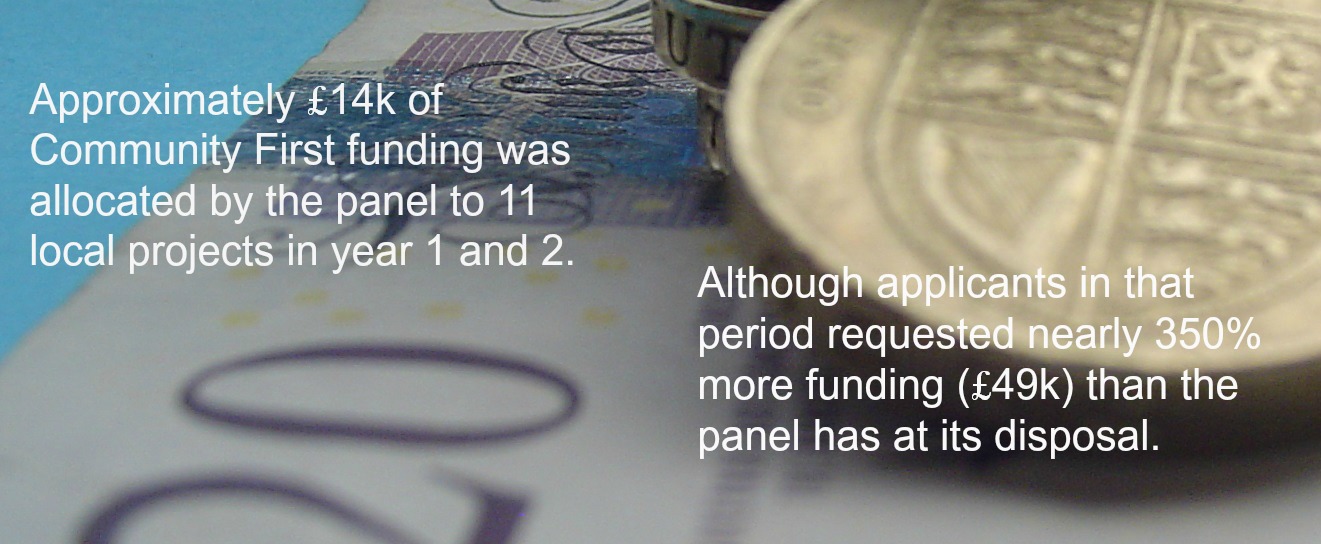
What Community First Funding Meant To One Ward In Year 1 And 2

Are you familiar with the concept of a Community First panel? 

If the answer is, ‘No’, here’s a brief explanation from my perspective, as a former panel chair.

‘Community First’ is the government’s neighbourhood improvement programme, running in England between 2012 and 2015.  The programme’s goal is to make funding available via a residents’ panel to not-for-profit organisations.  Those organisations will improve the quality of life in disadvantaged wards.

I think this approach could actually form the blue print for a future government wanting to devolve additional voluntary funding down to local communities via resident led panels.  That will depend on the panels functioning effectively, like the best project teams do.  The panels will still require thoughtful leadership and the input of skilled and confident volunteers.  Their legacy will involve changing the face of their neighbourhood.  A little work is necessary now to help make that legacy possible.

What are the panels doing at the moment?

As I write this post, residents‘ panels are deciding which local projects should receive a share of the final year of funding starting from April 2014.  The clock is ticking though, as panels need to submit their decisions to the government’s key delivery partner (the Community Development Foundation or CDF) by the end of March.

Local panels are a key part of the community based process, while other bodies have an overview of the bigger picture:  CDF is one of those bodies; Ipsos Mori the market research company is too, having evaluated the programme’s outcomes last year; the Young Foundation  is also an external partner supporting panels’ learning processes.

Which questions can the panel answer to help produce better future results?

Any project can benefit from holding a lessons learned exercise.  This exercise can provide valuable information to be used the next time similar work is commissioned.  I think the Young Foundation should encourage the panels to hold such an exercise and provide the answers to three questions this year.  This action forms a key part of the process of securing Community First’s panel legacy:

  • Which of the panel’s skills produced the bulk of the panel’s results?
  • What skills did the panel lack?
  • How could the panel produce even better results for their community if funding was available after 2015?

Answers to those questions should build up a picture of how panels produced good quality timely results, in a tough financial climate, and with limited volunteer resources.  Knowledge or skills gaps can then be filled by coaching or by mentoring.  Mapping that legacy now will also be invaluable if better results are expected from similar panels, by a future government.

Where can I find more information?

You can see some tweets about the programme from CDF, panels, and funded projects on Twitter if you use he #commfirst hashtag.

Click on the Podcasts tab above to listen to some questions you can answer to help you lead a panel (or a voluntary project) more easily.

Feel free to check out the Archive section for more thoughts on work and life goals.  There are further ideas relating to your work and life goals on Facebook and Google+ too

Goals 2014: One Step You Can Take To Be A More Confident & Resilient Carer

Are you feeling the strain of being a carer for an elderly parent or relative?  If the answer is “Yes” and you are in the UK then chances are you are a woman, rather than a man.  The current caring statistics and facts from Carers UK indicate that of the 3 million people in the country caring for relatives, 58% are women.

What does caring save?

Carers save the economy £119 billion per year (an average of £18,473 per carer).  However, 1 in 5 of those people who act as carers, whilst also working, are forced to give up work altogether.  The reason for this: the significant demands of combining caring and work.

What does caring cost you, the carer?

Caring obviously takes its toll on the woman, or man, making the effort to support their relative.  It can be emotionally demanding to support an elderly parent.  The carer’s well-being can take a knock.  It can also place a strain on the network of other important relationships in your life.  The emotional journey can affect your confidence too.

What questions could you ask yourself to establish how you feel about being a carer?

What is your goal regarding combining caring responsibilities with your working life? Where does your support come from while you are bearing the stress of supporting someone else?  What is the impact on your wider life and relationships of being a carer?

How do the key issues impact other people’s lives?

This question was aired in a moving edition of BBC radio 4’s Woman’s Hour today.  There are seemingly as many answers as there are carers.  For some carers unresolved family conflicts can be exposed by one person shouldering the responsibility of looking after a parent.  For others caring is an act of love, reflecting life long closeness and affection.

If you are UK Based you can find the recent editions of Woman’s Hour on iPlayer by searching for Radio 4 programming here  You can follow the programme on Twitter @BBCWomansHour

The Woman’s Hour discussion reminded me of a tweet  late last year, concerning how to manage challenging family relationships.  Do follow the link to read into the topic.

What action will you take this week to improve your confidence & resilience as a carer?

Developing an ever more secure adult identity helps: you are entitled to seek help and effective support.

How would you feel about making one inspired change, following International Women’s Day, this Saturday?  Could you share more information about the impact of your caring duties with your employer, partner, and friends?  How much better could your situation become if these important people truly understood what you were experiencing and provide you with more effective support this year?

Good luck to you as you take action to help improve your capacity to care for others and yourself.

Feel free to check out my Archive section for more thoughts on well-being and pursuing life goals.  There are further ideas relating to these areas on Facebook and Google+ too

Goals 2014: 5 Personal Questions To Improve Your Work & Family Life

This is the second of two posts about last week’s very first Work & Family Show at Excel, London.

Work & Family Show 2014 - Panel Discussion on the Language of Success

Work & Family Show 2014 – Panel Discussion on the Language of Success

Here’s a question.  Which one of your improvement goals has taken priority this year?  Is it improving some aspect of your work?  How about getting more from your personal or family life?

Whatever your priority you could have gained knowledge in any of these areas had you been at the Show.  The sponsor My Family Care and their partners put on practical, personal, and plenary sessions looking at the advice, inspirations and solutions that contribute to peoples’ ideal life balance.

From what I saw the audience of women on Maternity Leave, or taking a Career Break; people searching for their next job after redundancy and those looking to work flexibly, really engaged with the sessions on offer.

More details of the Work and Family event are set out here .  You can follow the feedback from the show on Twitter using the hashtag #wfshow

Personal Questions For Your Goal Setting Sessions

Meanwhile, here are the five personal insights I noted from the range of ideas offered by speakers last week.  I have added some bullet point questions for you, which you can use with your coach as you set your own goals:

On average Men are likely to apply for a promotion if they meet 60% of the recruitment criteria:

  • What more could you do to add to your skills, so you comfortably reach 70% of the recruitment criteria?

Women are likely to hold off applying for a promotion until they feel they meet 90% of the recruitment criteria:

  • What could you do to add to your skills, so you are confident you have 70% of the recruitment criteria?

You help yourself perform better by making time each day to check out your state of mind and take action, where necessary, to change limiting beliefs:

  • What is your strategy for taking stock of your inner state?

Making time to manage your personal / professional relationships in a considerate way makes your life easier:

  • How empathic are you when you manage your key relationships?

When you need to give feedback make time to pause, and comment on the behaviour rather than the individual’s personality:

  • Thinking about your previous bosses, whose feedback technique would you wish to emulate and why?

Feel free to check out my Archive section for more inspiration.  There are further ideas On Facebook and Google+ too.  Do feedback about your progress, via the Contact page here, or on Twitter @RogerD_said

Goals 2014: Goal Setting In Three Steps

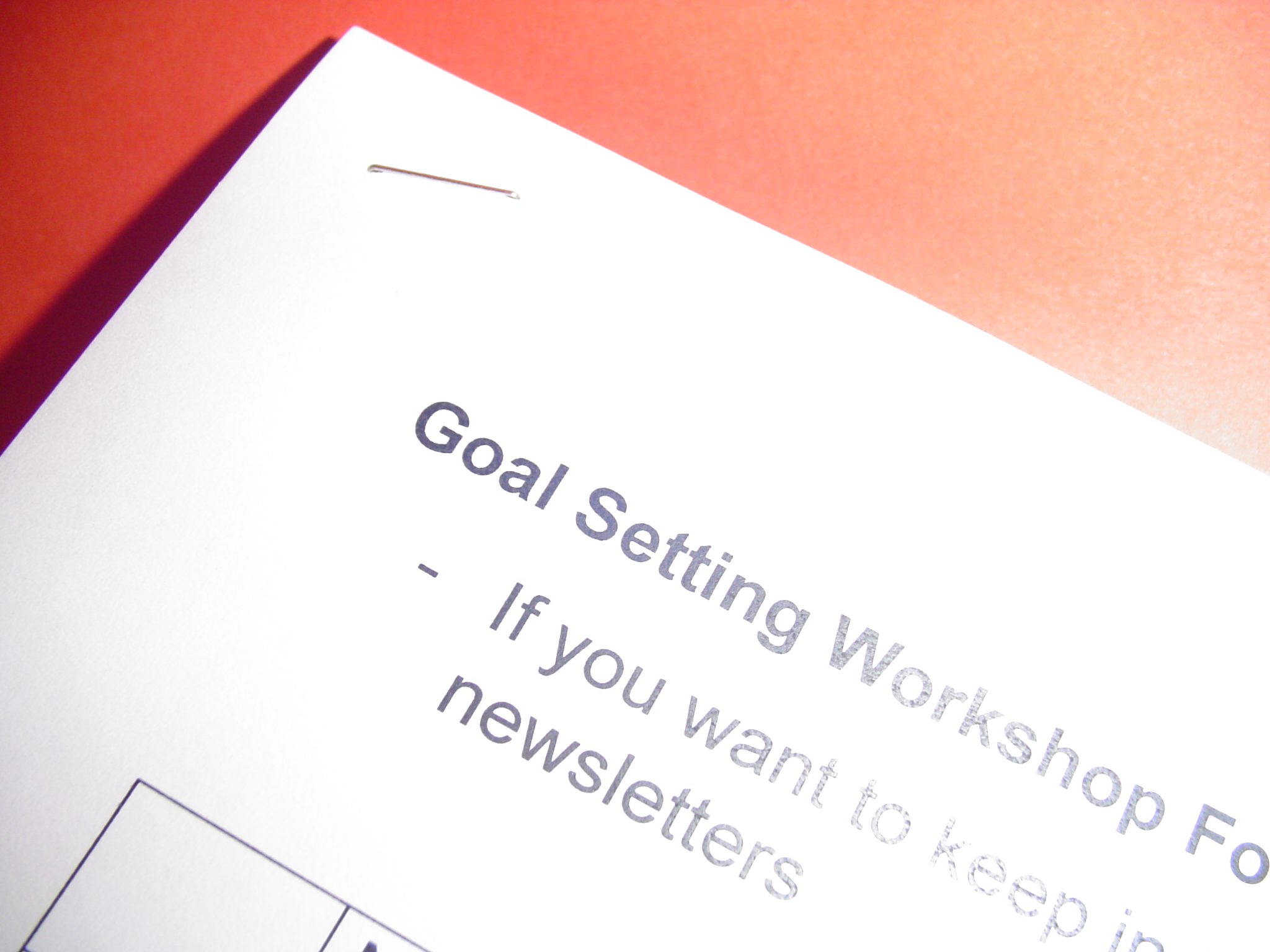
Workshop Paperwork

Goal Setting Starts Here


Congratulations on surviving January.  The first of February is a great time to concentrate on goal setting, action planning and clarifying values.  Here are three key questions to aid in that process:

  • What significant outcome do you want to have achieved by Easter?
  • How you will get there?
  • How does that effort fit with your core values?

Spending even thirty minutes today writing down your response to these questions is worthwhile.  Narrow your focus by expressing your goal in terms that are:

  • positive
  • present-tense
  • realistic

Writing down your first, significant, step to make progress toward your goal helps to underscore that you are confident that you can pursue and attain the outcome you that you want.  So does making an absolute commitment to taking prompt action.  An end date in your diary, with action milestones preceding it are powerful triggers to progress.

This process isn’t the preserve of the business world.  It applies in the public sector or the world of volunteering too.

It was great therefore to meet the volunteer team at The Asian Centre, Waltham Forest – @tacwf on Twitter – and support their work on #GoalSetting yesterday.  An evening in their company showed that goal setting helps volunteer mentors on a community programme, just like it does paid professionals working on costly projects.  Clients benefit too, whether they are young mentees, or high net worth customers.

If you would like to find out more about mentoring you can contact the Asian Centre via their website www.theasiancentrewf.org.uk for more information on their successful #YouthMentoring programme.

So, when will you make time to set your next significant goal?  How can effective coaching help you deliver on your commitment to self-development?

Click to Visit me on Facebook 

Goals 2014: How Happy Are You In Your Work?

These are some thoughts of mine in response to an idea from Miya Tokumitsu, revisited in the Guardian newspaper after originally appearing in Jacobin magazine.  Needless to say I don’t share the view that only the privileged are equipped to enjoy their work.

Having looked at the discussion how would you answer these questions:

  • How important is your work compared to your family or social life?
  • How happy does it make you feel?
  • Do you have a clear goal about what you want to happen within your life this year?
  • What will you feel like when you accomplish your goal?

Asking yourself these, hard, questions will help you decide what steps you will take to enjoy your work and social life in 2014.  Get in touch to discuss how I can help with that strategy.